Showing posts with label microsoft. Show all posts

Pro SQL Server Disaster Recovery Review

Pro SQL Server Disaster Recovery
Average Reviews:

(More customer reviews)
Are you looking to buy Pro SQL Server Disaster Recovery? Here is the right place to find the great deals. we can offer discounts of up to 90% on Pro SQL Server Disaster Recovery. Check out the link below:

>> Click Here to See Compare Prices and Get the Best Offers

Pro SQL Server Disaster Recovery ReviewThe book is just a re-hash of the original book they wrote 10 years ago. Any book that still references SQL Server 6.0 is just not worth buying.Pro SQL Server Disaster Recovery OverviewAs Today's businesses become increasingly reliant on the information they store in their various databases, so the effective protection of that data becomes ever-more critical. Potential disasters can arise from natural causes like floods and hurricanes, to user errors, to media or hardware failure. The process of disaster recovery involves mitigating the likelihood of a disaster and the process of returning the system to a normal state. It is intricately linked with the important areas of availability and business continuity-which ensure day-to-day activities can continue regardless of the problem.This book shows you how to implement an effective disaster recovery strategy for SQL Server 2005 and 2008 databases. You'll learn about powerful tools and features - such as Database Snapshots and Mirroring - for data backup and disaster recovery that are present in SQL Server 2005, and that are enhanced in SQL Server 2008. Users of SQL Server 2000 will find that the options for handling disaster recovery have increased dramatically. This book explores those options by examining the technical details of disaster recovery features and then applying that knowledge to practical scenarios. Also covered are fundamental changes to disaster recovery capabilities, and common issues to expect when using new features.

Want to learn more information about Pro SQL Server Disaster Recovery?

>> Click Here to See All Customer Reviews & Ratings Now
Read More...

MCTS Self-Paced Training Kit (Exam 70-536): Microsoft® .NET Framework Application Development Foundation, Second edition Review

MCTS Self-Paced Training Kit (Exam 70-536): Microsoft® .NET Framework Application Development Foundation, Second edition
Average Reviews:

(More customer reviews)
Are you looking to buy MCTS Self-Paced Training Kit (Exam 70-536): Microsoft® .NET Framework Application Development Foundation, Second edition? Here is the right place to find the great deals. we can offer discounts of up to 90% on MCTS Self-Paced Training Kit (Exam 70-536): Microsoft® .NET Framework Application Development Foundation, Second edition. Check out the link below:

>> Click Here to See Compare Prices and Get the Best Offers

MCTS Self-Paced Training Kit (Exam 70-536): Microsoft® .NET Framework Application Development Foundation, Second edition ReviewOverall, if you're considering taking the 70-536 exam, I recommend getting this book (not that there are a lot of alternatives). It may contain a few errors (honestly, I don't recall anything significant, right off hand), but the 2nd edition definitely alleviates at least most of the scores of pages of errors found in the first edition. Don't get the cheaper old edition: it's worth it to pay for the updated version, if only to avoid having to go through the 50+ pages of errata with the first edition.
This book does not cover everything in the same depth as the test, so if this is your only study tool, don't expect to feel completely comfortable when taking the exam or expect to "ace" it. As other posters have stated, you will need to do some of your own research if getting every question right is your goal. However, using ONLY this book as a study tool you CAN pass. Passing was my goal, and to that effect, this book accomplished its purpose effectively.
The tests provided on the CD did not seem much easier than the questions on the exam. Others may have had a different experience, but that was mine. I did notice that I "memorized" the answers rather quickly, and am glad I saved the tests on the CD until after I had already worked through the book, and could still use them to help polish my knowledge.
MCTS Self-Paced Training Kit (Exam 70-536): Microsoft® .NET Framework Application Development Foundation, Second edition Overview
Your 2-in-1 Self-Paced Training Kit. Fully updated and revised! Ace your preparation for the skills measured by MCTS Exam 70-536—and on the job. With this official Microsoft study guide, you'll work at your own pace through a series of lessons and reviews that fully cover each exam objective. Then reinforce and apply what you've learned through real-world case scenarios and practice exercises.

Maximize your performance on the exam by learning to:

Develop applications that use system types and collections
Validate input, reformat text, and extract data with regular expressions
Create services and multi-threaded applications
Implement code-access security and role-based security
Implement serialization to read and write complex objects
Leverage legacy code using interoperability
Monitor and troubleshoot applications
Create applications for a global audience

Practice Tests assess your skills with practice tests on CD. You can work through hundreds of questions using multiple testing modes to meet your specific learning needs. You get detailed explanations for right and wrong answers?including a customized learning path that describes how and where to focus your studies.

Your kit includes:

15% exam discount from Microsoft. Offer expires 12/31/13.
Official self-paced study guide.
Practice tests with multiple, customizable testing options and a learning plan based on your results.
300+ practice and review questions.
Code samples in Microsoft Visual Basic and Visual C# on CD.
Case scenarios, exercises, and best practices.
90-day evaluation of Microsoft Visual Studio Professional 2008.
Fully searchable eBook of this guide.

A Note Regarding the CD or DVD:

The print version of this book ships with a CD or DVD. For those customers purchasing one of the digital formats in which this book is available, we are pleased to offer the CD/DVD content as a free download via O'Reilly Media's Digital Distribution services. To download this content, please visit O'Reilly's web site, search for the title of this book to find its catalog page, and click on the link below the cover image (Examples, Companion Content, or Practice Files). Note that while we provide as much of the media content as we are able via free download, we are sometimes limited by licensing restrictions. Please direct any questions or concerns to booktech@oreilly.com.


Want to learn more information about MCTS Self-Paced Training Kit (Exam 70-536): Microsoft® .NET Framework Application Development Foundation, Second edition?

>> Click Here to See All Customer Reviews & Ratings Now
Read More...

Manage Software Testing Review

Manage Software Testing
Average Reviews:

(More customer reviews)
Are you looking to buy Manage Software Testing? Here is the right place to find the great deals. we can offer discounts of up to 90% on Manage Software Testing. Check out the link below:

>> Click Here to See Compare Prices and Get the Best Offers

Manage Software Testing ReviewI have read many testing books and this book surely has lots of material which is not covered elsewhere. However, the book frustrates you when you try out the examples or try to figure out what to do and what to leave out (theoretical). Those trying to learn things not offered in regular books can find this insightful.
Be warned that many ideas are not practically implementable - for example 18.10.6 - Bug seeding model where we deliberately insert bugs in code to estimate the # of defects. This is NEVER done in real life (my experience) since we have difficult time doing the actual project and eliminating the real bugs. The author does not warn you of this. There are many other cases where the author should warn you if its theoretical or practical some examples -
(1) Section 18.2.1 (Revised) Propagation Analysis Algorithm - Not possible in real software development with deadlines.
(2) 18.2.5 Revised Execution Analysis Algorithm
The author should have given the data and XLS in his blog (very difficult to locate) so that the readers can use the information. I vainly tried the example in 18.3.1 How to Calculate Influences on Performance and was so frustrated thathe changed the columns between figure 18.2 and 18.3 and gives so much data in 6th decimal (making it useless for the readers when we are not able to follow).
On the positive side - there are a lot of insight in terms of reliability covered here. The references are very good and useful. It should have more stars if the XLS were provided or examples made more understandable.Manage Software Testing OverviewWhether you are inheriting a test team or starting one up, Manage Software Testing is a must-have resource that covers all aspects of test management. It guides you through the business and organizational issues that you are confronted with on a daily basis, explaining what you need to focus on strategically, tactically, and operationally. Using a risk-based approach, the author addresses a range of questions about software product development. The book covers unit, system, and non-functional tests and includes examples on how to estimate the number of bugs expected to be found, the time required for testing, and the date when a release is ready. It weighs the cost of finding bugs against the risks of missing release dates or letting bugs appear in the final released product. It is imperative to determine if bugs do exist and then be able to metric how quickly they can be identified, the cost they incur, and how many remain in the product when it is released. With this book, test managers can effectively and accurately establish these parameters.

Want to learn more information about Manage Software Testing?

>> Click Here to See All Customer Reviews & Ratings Now
Read More...

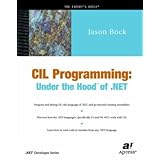
CIL Programming: Under the Hood of .NET Review

CIL Programming: Under the Hood of .NET
Average Reviews:

(More customer reviews)
Are you looking to buy CIL Programming: Under the Hood of .NET? Here is the right place to find the great deals. we can offer discounts of up to 90% on CIL Programming: Under the Hood of .NET. Check out the link below:

>> Click Here to See Compare Prices and Get the Best Offers

CIL Programming: Under the Hood of .NET ReviewHas this ever happened to you... There's this new technology or programming language that you're dying to learn, but there are no books. Finally, someone writes a book, you get the book from the bookseller (Amazon), you open the book, and you thumb through the pages. Well, that's the way I felt about learning Microsoft IL for .NET. I really was keen about learning .NET's "assembly language" because throughout my career I found that having low level knowledge about how a system is put together is very, very useful. Now, I'm not suggesting that you stop everything you're doing and run out to learn CIL programming. However, I believe that if you want to be a serious .NET professional, learning CIL should definitely be on your To-Do list.
So what about Bock's Book: "CIL Programming: Under the Hood of .NET"? In a word - disappointing. Bock spends most of the book's first chapter entitled "Language Interoperability" on detailed discussion of programs written in a variety of languages. He's trying to make the point that the CLR allows programs written in different languages to freely interoperate. Duh? Why spend the better part of the book's opening talking about everything but CIL. There's even an Oberon (?) programming sample here.
The second and third chapters on ILASM Directives, and, CIL Opcodes, respectively, read like my weekend shopping lists. While it is true that programming books have to regurgitate all the nasty details of the programming language, the good books tell its readers how to internalize the information and describe useful ways of summarizing the information in one's mind. That is, the authors of the better books have figured out some rhyme and reason to the language and they share these insights with their readers. On the other hand, this is what I found in these two most important chapters of Bock's book: the more I read, the more questions I had. I wound up spending significant time on the NET trying to resolve questions that were raised in the material in these two chapters. Clearly, the author did not anticipate these questions.
The fourth chapter, "ILASM and CIL in Practice" is a decent discussion of a typical sample program in IL. It demonstrates some of the IL constructs and programming concerns discussed in the previous chapters.
Chapter 6 is interesting. Here the author talks about and contrasts the IL generated by various programming languages. Some of the VB.NET and C# exposés were eye-opening, but then Bock goes back to Oberon again.
The author ends off the book in chapters 7 and 8 with some very long and tedious samples. I got nothing from this. Chapter 9, the last in the book, is a two-pager on "CIL Tips".
So why do I give this book 3 stars?
1) The book includes Chapter 5, a well-written and interesting discussion about CIL Debugging.
2) Right now, Bock's book is one of three books that talk about CIL. It is the only book that is targeted directly at programming. Although John Gough's "Compiling for the .NET Common Language Runtime" is an excellent book, it is very specialized and targets would-be compiler authors. I didn't read the third book in the IL arena, Serge Lidin's "Inside Microsoft .NET IL Assembler", but I did thumb through it several times (you know what little that is worth): this book strikes me as being very difficult.
RECOMMENDATIONS:
If you need to learn IL Programming right now, buy Bock's book - read the second half of chapter 1, and read Chapters 2-5, maybe Chapter 6. If you have the time, money, and inclination, then buy and read Gough's book. You'll need a lot of time for Gough, but you will definitely learn.
If learning IL is not that pressing right now, I would wait to see if someone else releases a better book.CIL Programming: Under the Hood of .NET OverviewFor the most part, .NET developers use a high-level language, such as C# or VB .NET, to develop their systems. However, the core language of .NET is the Common Intermediate Language, or CIL. This language is the language of .NETdevelopers can use CIL to do whatever is allowed by the .NET specifications, which is not the case for C# and VB .NET. Although it is unlikely that the majority of .NET developers will create their assemblies in CIL, understanding how CIL works will give them a deep, language-independent insight into the core parts of .NET. Furthermore, such knowledge is essential for creating dynamic types, a powerful part of the .NET Framework.In CIL Programming: Under the Hood of .NET, Jason Bock covers the essentials of programming the CIL. First, Bock discusses the basics of what .NET assemblies are and how manifests fit into the picture. He then shows how to create assemblies in .NETincluding the ilasm directives and CIL opcodes, and how these are used to define assemblies, classes, field, methods, and method definitions. Bock also covers how C# and VB .NET and other non-MS languages emit CIL and how they differ. Finally, he reveals how developers can create dynamic assemblies at runtime via the Emitter classes.After reading CIL Programming: Under the Hood of .NET, developers will have a better understanding of the CIL and how to program directly into it. A must-have on every .NET developers desk!Jason Bock is consultant and instructor for Intertech-Inc. (a company devoted to delivering hands-on workshops for enterprise web developers and whose focus is the professional Java, XML, and .NET enterprise developer).He has worked on a number of business applications using a diverse set of substrates and languages such as C#, .NET, and Java. He is the author of ".NET Security" by Apress, and "Visual Basic 6 Win32 API Tutorial, and has written numerous articles on technical development issues associated with both VB and Java.Jason holds a B.A. and a Masters degree in Electrical Engineering from Marquette University.You can find out more about him at http://www.jasonbock.net

Want to learn more information about CIL Programming: Under the Hood of .NET?

>> Click Here to See All Customer Reviews & Ratings Now
Read More...

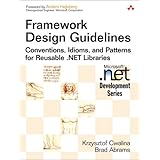
Framework Design Guidelines: Conventions, Idioms, and Patterns for Reusable .NET Libraries Review

Framework Design Guidelines: Conventions, Idioms, and Patterns for Reusable .NET Libraries
Average Reviews:

(More customer reviews)
Are you looking to buy Framework Design Guidelines: Conventions, Idioms, and Patterns for Reusable .NET Libraries? Here is the right place to find the great deals. we can offer discounts of up to 90% on Framework Design Guidelines: Conventions, Idioms, and Patterns for Reusable .NET Libraries. Check out the link below:

>> Click Here to See Compare Prices and Get the Best Offers

Framework Design Guidelines: Conventions, Idioms, and Patterns for Reusable .NET Libraries ReviewDepending on your experience with the .NET framework, you may consider the contents of this book as everything from invaluable insights to mildly amusing explanations of a few details of .NET you've always wondered about.
Krzysztof Cwalina and Brad Abrams have worked with designing the public API of the .NET framework from its beginning, and during that process they have compiled a comprehensive guideline for framework design. It is basically this internal guideline they are now publishing as a book.
The text is easy to read and makes for a good reference book. It is littered with more free-form comments from lots of other experts such as Jeffrey Richter, Christopher Brumme, and the occasional comment from Anders Hejlsberg. However, it is mostly reminiscent of a Word document with lots of revision comments liberally sprinkled all over, and I suspect this is how book was made: Take an internal guideline document and polish it off; pass it around to a lot of collegues in Microsoft and ask them to comment on it; incorporate most comments verbatim in the text; and publish.
That said, I still found myself using lots of the little insights in the book in my work in the weeks after having read it. Most of those insights actually came from the free-form comments, so I'm not complaining.
If you use FxCop and are familiar with many of the rules in this tool, most of the guidelines in this book will come as no surprise to you. FxCop was originally a project of Krzysztof's and Brad's designed to automate much of their code review work, so you can learn most of the contents of this book just by using FxCop.
As such, almost all the guidelines in the book are publicly known material, but it's still a well organized reference, and the little extra comments from the authors and lots of other people are what made this book a worthwhile read for me.
I wouldn't consider this book essential reading for .NET developers, but it basically supplements FxCop pretty well.Framework Design Guidelines: Conventions, Idioms, and Patterns for Reusable .NET Libraries OverviewA new edition of this title is available, ISBN-10: 0321545613 ISBN-13: 9780321545619"This book is an absolute must-read for all .NET developers. It gives clear do and don't guidance on how to design class libraries for .NET. It also offers insight into the design and creation of .NET that really helps developers understand the reasons why things are the way they are. This information will aid developers designing their own class libraries and will also allow them to take advantage of the .NET class library more effectively."--Jeffrey Richter, author/trainer/consultant, Wintellect"Framework Design Guidelines will help you in two important ways. First, any .NET developer will benefit from a greater understanding of the design principles that govern the .NET Base Class Library. Second, a deeper understanding of these principles will help you to create software that integrates well with the .NET environment. Quite frankly, this book should be on every .NET developer's bookshelf." --Bill Wagner, founder and consultant, SRT Solutions, author of Effective C#"Not since Brooks' The Mythical Man Month has the major software maker of its time produced a book so full of relevant advice for the modern software developer. This book has a permanent place on my bookshelf and I consult it frequently."--George Byrkit, senior software engineer, Genomic Solutions"This book is a must-read for all architects and software developers thinking about frameworks. The book offers insight into some driving factors behind the design of the .NET Framework. It should be considered mandatory reading for anybody tasked with creating application frameworks."--Peter Winkler, senior software engineer, Balance Technology Inc."Frameworks are valuable but notoriously difficult to construct: Your every decision must be geared towards making them easy to be used correctly and difficult to be used incorrectly. This book takes you through a progression of recommendations that will eliminate many of those downstream 'I wish I'd known that earlier' moments. I wish I'd read it earlier."--Paul Besly, principal technologist, QA"Filled with information useful to developers and architects of all levels, this book provides practical guidelines and expert background information to get behind the rules. Framework Design Guidelines takes the already published guidelines to a higher level, and it is needed to write applications that integrate well in the .NET area."--Cristof Falk, software engineerFramework Design Guidelines: Conventions, Idioms, and Patterns for Reusable .NET Libraries teaches developers the best practices for designing system frameworks and reusable libraries for use with the Microsoft .NET Framework and WinFX. This book focuses on the design issues that directly affect the programmability of a framework, specifically its publicly accessible APIs. This book can improve the work of any .NET developer producing code that other developers will use. An added benefit is a collection of annotations to the guidelines by various members of the Microsoft .NET Framework and WinFX teams, which provide a lively discussion of the motives behind the guidelines, along with examples of good reasons for breaking the guidelines.Microsoft architects Krzysztof Cwalina and Brad Abrams offer guidelines for framework design from the top down. From their long experience and deep insight, you will learnThe general philosophy of framework design Principles and guidelines that are fundamental to overall framework design Naming guidelines for the various parts of a framework, such as namespaces, types, and members Guidelines for the design of types and members of types Issues and guidelines that are important to ensure appropriate extensibilityin your framework Guidelines for working with exceptions, the preferred error reporting mechanism in the .NET Framework and WinFX Guidelines for extending and using types that commonly appear in frameworks Guidelines for and examples of common framework design patternsGuidelines in this book come in four major forms: Do, Consider, Avoid, and Do not. In general, a Do guideline should almost always be followed, a Consider guideline should generally be followed, an Avoid guideline indicates that something is generally not a good idea, and a Do not guideline indicates something you should almost never do. Every guideline includes a discussion of its applicability, and most guidelines include a code example.A companion DVD includes the Designing .NET Class Libraries video series, instructional presentations by the authors on design guidelines for developing classes and components that extend the .NET Framework. A sample API specification and other useful resources are also included.

Want to learn more information about Framework Design Guidelines: Conventions, Idioms, and Patterns for Reusable .NET Libraries?

>> Click Here to See All Customer Reviews & Ratings Now
Read More...