Average Reviews:

(More customer reviews)Are you looking to buy
Designing Interactions? Here is the right place to find the great deals. we can offer
discounts of up to 90% on
Designing Interactions. Check out the link below:
>> Click Here to See Compare Prices and Get the Best Offers
Designing Interactions Review(I originally gave this book a more positive review. Amazon won't let me change the star rating. I give this book TWO stars, not four.)
This book is fairly impressive at first glance. Seven-hundred plus pages, adequately footnoted, and nicely designed. I can't imagine anyone in the field of interaction design not enjoying cracking open Moggridge's book.
But "Designing Interactions" isn't quite what I thought it would be, and my first optimistic impressions were terribly wrong. It is, as Bruce Sterling's blurb describes it, "a labor of love." It's really "The History of Designing Interactions." More specifically, it's "The History of how Bill Moggridge, his company IDEO, and A Few Other People Mostly in California Designed Interactions." It's something of a hagiography--biographies of designer-saints, whose every effort was nothing less than beautiful, innovative, useable and useful. Failures, missteps, or significant-but-ugly designs (Windows 3.1 gets about a sentence) are minimized. That makes it feel like something of a whitewash.
It actually reminds me a lot of "The Art of Unix Programming" in its combination of cultural and technological history, mixed with practical sections. But where the people in "The Art of Unix Programming" come across as modest smart people, sort of tinkering along inventing an entire paradigm, Moggridge's subjects are sort of bathed in this golden California glow of eternal optimistic technophilia; it's not that the design of buttons and menus isn't a moral, cultural, and aesthetic imperative (cause it is), but in Moggridge's text it just all feels a little...inevitable. It's also historically dubious. Moggridge doesn't use interviews well, and they seem to be basically his only research here. Relying on the memories of his old design buddies is an extraordinarily sloppy way to write history. Other evidence for claims and facts is sadly lacking. Readers need to bring a very skeptical eye to the content here.
It's also depressingly full of IDEO work, IDEO employees, and IDEO methods. Which would almost be ok if Moggridge were more transparent about his own role as founder and current senior employee of that company. As it is, the conflict of interest here is a pretty crass. (After all, Moggridge stands to personally and professionally benefit from defining "interaction design" entirely around his own business, right?)
But I think if you do this kind of work, you'll enjoy the histories of the mouse, the menu, or the Palm Pilot, and seeing lots of sketches and diagrams and screenshots. It *is* kind of cool to see stuff like Bill Atkinson's sketches of the Apple Lisa. It also feels quite current, and there are good sections on mobile devices, patterns of technology adoption, play, service design, critical design, and ubiquitous computation. Though the downside of this breadth is that the whole thing feels like a grab bag approach. There are more than a few genuinely disappointing parts: the chapter on the internet is pretty poor, basically equating "the Internet" with Google and a couple of long-gone fancy web navigation experiments. It's a chapter that's little more than a Silicon Valley courtier's homage to the boy kings Larry and Sergey. What's this doing in a book on interaction design, Bill?
It's interesting to compare "Designing Interactions" with Dan Saffer's new book with a slightly different title: "Designing for Interaction." Both books use interviews, but Saffer's are short sidebars, Moggridge's book is *mostly* interviews. Though Moggridge's last chapter is a practical section, about the length of Saffer's whole book, Saffer *still* manages to cover a lot more of the nuts and bolts, day to day work of interaction design.
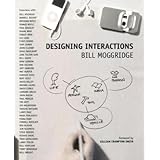
Designing Interactions OverviewDigital technology has changed the way we interact with everything fromthe games we play to the tools we use at work. Designers of digital technologyproducts no longer regard their job as designing a physical object--beautiful orutilitarian--but as designing our interactions with it. In Designing Interactions,award-winning designer Bill Moggridge introduces us to forty influential designerswho have shaped our interaction with technology. Moggridge, designer of the firstlaptop computer (the GRiD Compass, 1981) and a founder of the design firm IDEO,tells us these stories from an industry insider's viewpoint, tracing the evolutionof ideas from inspiration to outcome. The innovators he interviews--including WillWright, creator of The Sims, Larry Page and Sergey Brin, the founders of Google, andDoug Engelbart, Bill Atkinson, and others involved in the invention and developmentof the mouse and the desktop--have been instrumental in making a difference in thedesign of interactions. Their stories chart the history of entrepreneurial designdevelopment for technology.Moggridge and his interviewees discuss such questions aswhy a personal computer has a window in a desktop, what made Palm's handheldorganizers so successful, what turns a game into a hobby, why Google is the searchengine of choice, and why 30 million people in Japan choose the i-mode service fortheir cell phones. And Moggridge tells the story of his own design process andexplains the focus on people and prototypes that has been successful at IDEO--howthe needs and desires of people can inspire innovative designs and how prototypingmethods are evolving for the design of digital technology.Designing Interactions isillustrated with more than 700 images, with color throughout. Accompanying the bookis a DVD that contains segments from all the interviews intercut with examples ofthe interactions under discussion.Interviews with:Bill Atkinson • DurrellBishop • Brendan Boyle • Dennis Boyle • Paul Bradley • DuaneBray • Sergey Brin • Stu Card • Gillian Crampton Smith • ChrisDowns• Tony Dunne • John Ellenby • Doug Englebart • Jane FultonSuri • Bill Gaver • Bing Gordon • Rob Haitani • Jeff Hawkins• Matt Hunter • Hiroshi Ishii • Bert Keely • David Kelley •Rikako Kojima • Brenda Laurel • David Liddle • Lavrans Løvlie •John Maeda • Paul Mercer • Tim Mott • Joy Mountford • TakeshiNatsuno • Larry Page • Mark Podlaseck • Fiona Raby • CordellRatzlaff • Ben Reason • Jun Rekimoto • Steve Rogers • FranSamalionis • Larry Tesler • Bill Verplank • Terry Winograd •Will Wright
Want to learn more information about
Designing Interactions?
>> Click Here to See All Customer Reviews & Ratings Now

